“We only looked at this moon for minutes of time with the James Webb Space Telescope, and we already made a new discovery,” Webb deputy scientist Stefanie Milam said.
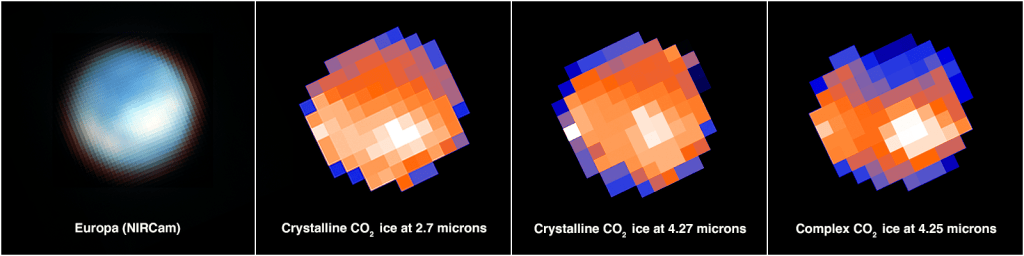
Astronomers recently discovered a layer of carbon dioxide that coats the icy surface of Jupiter’s moon Europa. This discovery marks a new precedent for the capabilities of the James Webb Space Telescope.
“Europa being one of our closest bodies that actually has one of these ocean worlds beyond Earth is a really intriguing object,” Milam said.
Europa’s geography features a water ocean just beneath its surface. Analyzing data gathered by Webb, astronomers detected this carbon source in the Tara Regio: a specific region on Europa that suggests a correlation between the origins of this discovery and the subsurface ocean. This unique characteristic is the reason scientists suggest the exoplanet may be an ocean world. The telescope, for the first time, identified carbon dioxide that could have originated from water — a crucial building block of life.
“But having these bodies where there’s this huge ocean beneath an icy crust suggests that there’s something causing that to remain fluid and that’s huge implications for understanding what the composition of that ocean is,” Milam said.
She adds that this finding is exciting as it opens the door for further investigation into the potential for habitable conditions.
With a course set for Jupiter’s moon the Europa Clipper spacecraft is scheduled to launch in October next year to do just that. It is expected to reach the icy Jupiter moon in 2030.
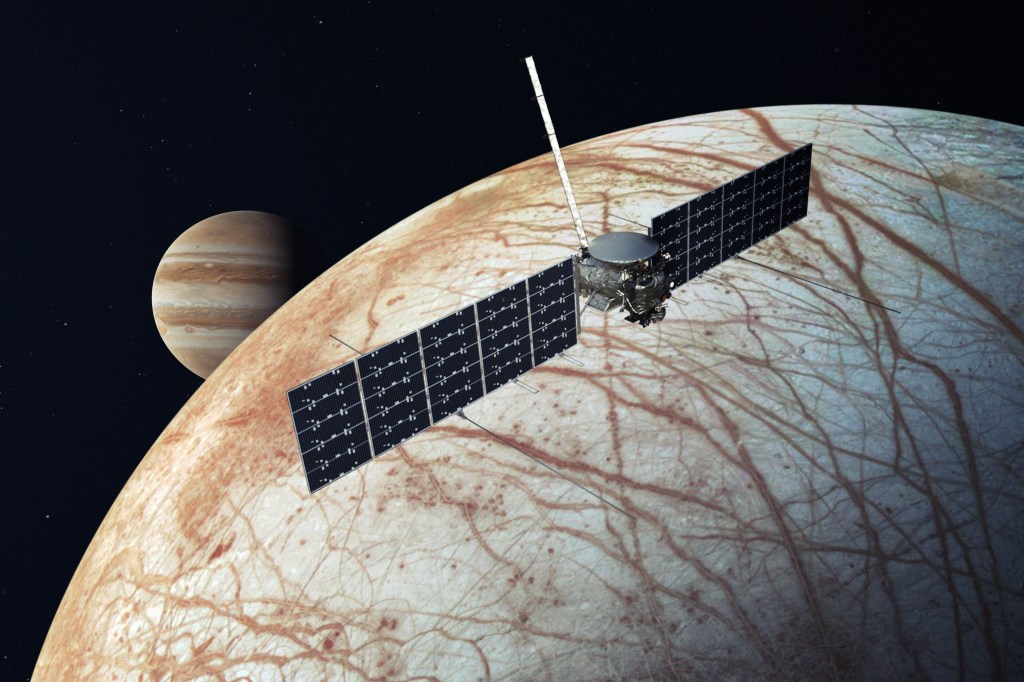
JUICE, a separate spacecraft designed by the European Space Agency and NASA, launched on April 4th this year and will study Europa alongside Jupiter itself and two of its other moons

 The Exploratory Journal