Those fascinating creatures commonly known as “jellyfish” are actually not fish at all. In fact, Jellies are more closely related to corals and anemones.
This diverse group of invertebrates is known for their umbrella-like body—the “bell”— from which their long tentacles flow. Their tentacles have specialized cells, called nematocysts, that inflict a sting. Along their tentacles, some jellies have parts called “oral arms.”
Cosmic Jelly
What is a jellyfish article without a single line dedicated to the most brilliant one of them all? This deep sea wonder is known as Rhopalonematid trachymedusa. Noting it’s supernatural glow, NOAA Ship Okeanos Explorer researchers named this jellyfish the “Cosmic Jelly.” They discovered this jelly while exploring American Samoa in 2017.

Mangrove Jelly
You can look, but you can’t touch. Actually, that wouldn’t apply to the Mangrove Jellyfish because it is a type of jelly known as Cassiopea. This upside-down jellyfish can sting prey without physical contact, according to a 2021 study on this genus of jelly.
“Swimmers and waders may put themselves at risk simply by coming into contact with agitated water in the vicinity of Cassiopea medusae, even without touching any part of the jellyfish (medusa, tentacles, or otherwise),” researchers wrote.
Mangrove Jellyfish have algae living inside its oral arms. The jelly rests upside-down on the seafloor so the algae can absorb sunlight. Through a process called photosynthesis, the algae provides nutrients to its host. It’s a win-win scenario. Housing in exchange for food.
This mutually beneficial relationship is known as symbiosis. Many jellies form relationships with tiny crustaceans and juvenile fish. Some young fish hide among jellyfish tentacles to avoid predators. Scientists are curious about what, if anything, jellies might get in return.
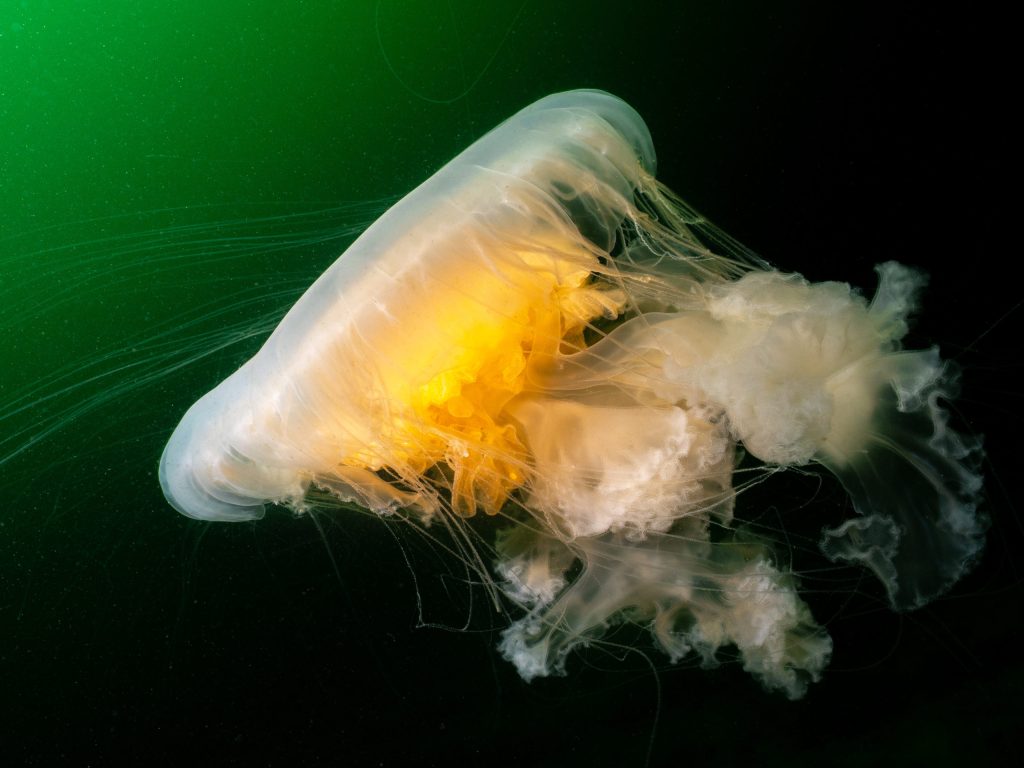
The Egg-Yolk Jelly
On the first impression, this species can look like a runny fried egg, but it’s actually Phacellophora camtschatica, commonly known as the “egg-yolk jelly.”
Flourishing in the Pacific waters of Monterey Bay, this “over-easy” jelly drifts through open waters, serving as food for marine birds, sea turtles, and fish.
Too much of anything is never a great idea.
A large gathering of jellies is referred to as a “bloom” or a “smack.” Trends of warmer ocean waters have led to an overabundance of phytoplankton and zooplankton, which are food for jellies. This surplus in food gives the jellies more than they need to grow and reproduce.
Over the past two decades, coastal regions have seen a surge in the number of jelly blooms.
Since populations of animals that eat jellies have been reduced by humans over the years, according to a Frontiers in Marine Science study, these explosions of jellies in areas around the globe continue to negatively impact the natural balance of ecosystems.
“Blooms also cause problems for aquaculture by fouling net pens and jellyfish nematocyst-rich mucus is responsible for fish gill disorders (Purcell et al., 2013),” Researchers noted in the study.
Food webs like the California Current marine ecosystem support important fisheries and local economies.
Changes to the climate and ocean temperatures can dramatically affect these delicate ecosystems.

 The Exploratory Journal