Torrential rains left palm trees in the Sahara desert up to their fronds in water. Meteorologists are calling those plentiful late summer showers an extratropical storm. This is the first flood in more than 50 years to impact a region of the world’s largest non-polar desert that had previously been arid. The event comes after a nearly six-year-long drought.
As reported by NASA Earth Observatory in September, the barrage of rainfall came in the wake of a northward shift of clouds that usually hang around the equator. One image from the MODIS (Moderate Resolution Imaging Spectroradiometer) on NASA’s Terra satellite clearly shows a blue lagoon creating a sizable oasis in the middle of the Sahara.
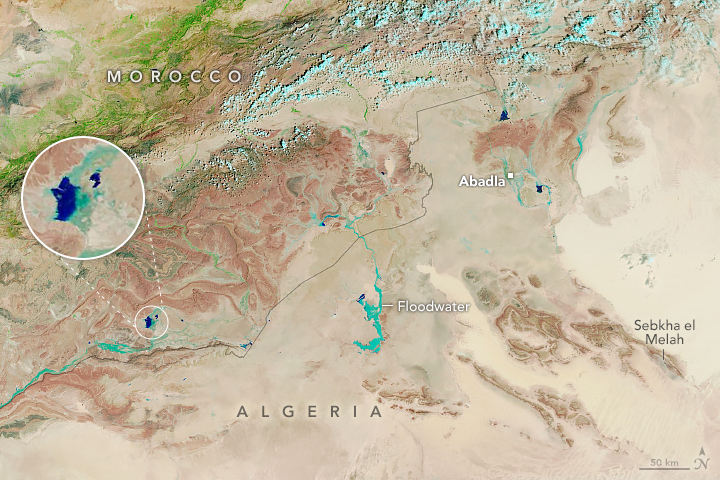
According to the Associated Press, that same rainfall pummeling the southeastern region of Morocco left 20 people dead. Surrounding Moroccan communities also suffered damaged homes and roads and were left without power due to the unexpectedly heavy precipitation.
The effect of the added moisture in the desert air opens the door for new possibilities in the course of future weather in the region. Houssine Youabeb of Morocco’s General Directorate of Meteorology told the AP this could lead to continued storms. It is unknown whether the additional showers could create an overflow in the water supply for desert towns.

 The Exploratory Journal